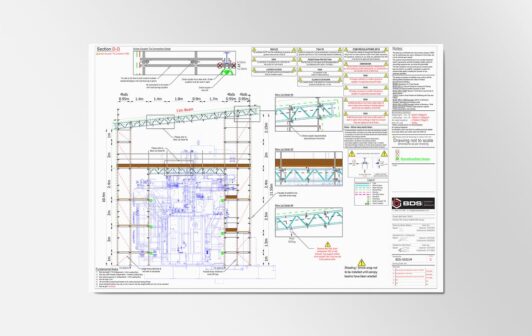


On heritage sites, early integration makes the difference when it’s time to patch up the cracks. But, scaffold design on any heritage site will come against access issues and unique obstacles that require a fresh approach.
It’s easy to think our modern solutions will bypass ancient problems in an instant, but the second you step onto site at a 200-year-old church or a listed Georgian façade, the normal rules start to fall away.
If we were to tie into the wrong mortar joint, or load a scaffold onto a shallow vault, we’d create lasting damage you can’t hide.
It’s a tough lesson to learn, but heritage scaffold design isn’t the standard issue with some extra care bolted on.
At BDS we treat it as a different discipline altogether.
We’ve seen both sides of the coin, and to get the best results, you need to tackle the design and the tools together. There’s a difference between a drawing that looks tidy in CAD and a scaffold that actually works when we’re standing in front of a 200-year-old building, with the job of protecting it.
For guidance on temporary works affecting historic structures, organisations such as Historic England provide detailed recommendations, but translating that guidance into practical scaffold design requires site experience…
Table of Contents:
- Why Heritage Scaffold Design Is Fundamentally Different
- What Makes Scaffolding Historic Buildings More Complex?
- The Role of the Scaffold Designer in Heritage Projects
- Common Design Solutions for Heritage Buildings
- Listed Building Consent and Scaffolding
- Grade I, II and II: Why the Level Matters*
- Why Site Experience Makes the Difference
- Answering the Key Questions
Why Heritage Scaffold Design Is Fundamentally Different
The biggest mistake on heritage projects is assuming we can treat them like modern builds.
We’ve seen many sites where the usual rules had to be thrown away, and a creative solution had to be found.
“On one project at Haigh Hall, we weren’t allowed to butt the walls, let alone tie into them. Even marking the masonry was unacceptable. So, keeping the scaffold freestanding under heavy wind load meant detailed frame analysis and significant kentledge, simply to protect the fabric.”
What Makes Scaffolding Historic Buildings More Complex?
When designing scaffolding for historic buildings, you are often dealing with:
- Soft or weathered stonework that cannot tolerate aggressive fixings
- Lime mortar joints that won’t hold modern expansion anchors
- Unknown cavities or voids behind façades
- Original timber elements that are irreplaceable
- Vaulted cellars or shallow footings with limited bearing capacity
- Ornate features such as cornices, carvings, and statues that must not be disturbed
- Tie locations may be severely limited
- Drilling can be prohibited altogether
- The ground below may conceal archaeology or fragile services
Heritage scaffold design starts from a different place: It protects the building first, then solves the access issues second.
The Role of the Scaffold Designer in Heritage Projects
It can be difficult to put efficiency to one side in favour of a much slower, methodical approach. Our job is to design efficient, cost-effective scaffold designs, with as little delay and impact as possible for the contractor.
Heritage projects require a complete switch up in approach. We’ll still need to produce calculations and drawings that meet compliance expectations whilst remaining buildable and cost effective, but now our team is part of the conservation conversation too.
On larger heritage building restoration projects, scaffold design drawings are often reviewed alongside conservation method statements and structural reports. That level of scrutiny demands clarity, detail and justification from the outset.
It can sound obvious at first, but the level of detail needed demands an intricate understanding of the site:
- Review the building fabric and identify constraints early
- Understand which areas are protected and why
- Liaise with architects and conservation officers
- Propose access solutions that minimise intervention
- Anticipate site realities before they become problems
In our experience, we find that early engagement is critical. The biggest gap between designs that work and those that don’t is how connected the designer stays to the team tasked with renovating the building.
With so many variables both on and off the site, solid communication avoids making scaffolding a last minute consideration. If you involve scaffold design early on in a heritage project, access assumptions and site specifications can be adapted and you can:
- Avoid designs that rely on tie positions that will never be approved
- Prevent clashes with protected features
- Build scaffold strategy into the method statement from the outset
- Save time in the listed building consent process
If you make just one change when handling heritage sites, it’s ensuring the scaffold design is integrated early. When it is integrated early, the scaffold can be designed around the building rather than against it.
If you treat it as an afterthought, we guarantee you’ll find compromises on solutions that will directly result in compromises in quality.
Common Design Solutions for Heritage Buildings
The main takeaway is that every heritage structure is different. No templates can make up for the demands of older structures, and you can expect to find more obstacles the more you understand the site.
In our experience, there is no value in applying a ‘heritage scaffold design template’ to a site. We all love a ‘perfect plan’, but it’s a trap. If you only ever do things according to templates and previous successful processes, you won’t have the flexibility to work with a heritage site.
Instead, we recommend using a modular approach. There are recurring principles and solutions that are often used in heritage building restoration designs, which can be adapted to different obstacles.
We’ve applied these principles across churches, historic town halls and listed façades, adapting each solution to the structure rather than forcing a standard layout.
See our heritage scaffold design case studies
Buttressed Scaffolds
A buttressed scaffold is often used where tying into the structure is restricted or prohibited.
Instead of relying heavily on façade ties, the scaffold is stabilised using raking buttresses, increased base widths or return sections that provide lateral stability.
These designs can be more material-intensive, but they reduce intervention into historic fabric.
Best for: Buttressing is particularly useful on stone churches, historic façades and listed civic buildings where drilling for anchors is not acceptable.
Non-Invasive Scaffold Design
A non-invasive scaffold design aims to minimise or eliminate fixings into the building, and can involve:
- Compression ties positioned in window reveals where appropriate
- Reveal ties that avoid drilling into masonry faces
- Through-ties only where agreed and reversible
- Independent scaffolds stabilised through kentledge
The key principle is reversibility. Any intervention should be capable of being removed without permanent damage.
Non-invasive does not mean no engineering. It often means more engineering, more calculation and more thought.
Kentledge and Load Management
Where tying is limited, kentledge (counterweights) can be used to provide stability.
On heritage sites, this requires careful consideration of:
- Ground bearing capacity
- Vaulted basements
- Suspended slabs
- Fragile paving or cobbles
Remember: load distribution becomes critical. Spreader beams, sole boards and load mats are often required to prevent point loading.
Understanding how weight travels through an old building is a practical skill and you will need to take it beyond the theory behind your ‘perfect plan’. Remember to have a complete understanding of what might be beneath your base plates before you commit to a design.
Birdcage Scaffolds
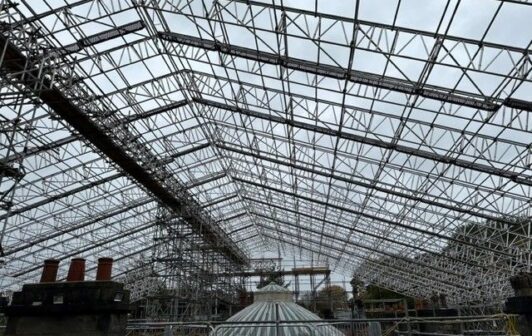
For internal restoration work, particularly in churches and large halls, birdcage scaffolds are common.
These provide a stable working platform without relying on wall ties. As we’ve already discussed, internal heritage work brings its own risks, including:
- Timber floors that cannot take concentrated loads
- Decorative plaster ceilings beneath
- Limited access routes for materials
Again, the design must respect what is there, rather than what looks ‘best’ on paper…
Listed Building Consent and Scaffolding
Scaffolding might be temporary, but the impact on a listed building isn’t.
It’s a common misconception, but when you’re working on a listed building, a single scratch can cause major fallout. In every phase of the project, avoid assumptions and take an extra chunk of time to solidify the details.
Despite the fact that temporary works such as scaffolding do not automatically require listed building consent, you’ll likely need consent if your heritage scaffold design involves:
- Drilling into historic fabric
- Removing or altering features
- Affecting protected elements
- Remaining in place for extended periods
Conservation officers and inspectors will typically want to see:
- How the scaffold is to be fixed (or not fixed)
- Details of tie positions
- Evidence that intervention is minimised
- A clear method statement
- Confirmation that any alterations are reversible
A well-prepared scaffold design submission can make this process far smoother. Remember, working with the obstacles, and producing drawings that reflect the detail and communication across teams will significantly expedite this process.
Heritage scaffold design drawings need to demonstrate that the designer understands the building, not just scaffolding in general. That’s why scaffold design for a listed building should never be treated as a generic temporary works submission.
Grade I, II* and II: Why the Level Matters
The level of listing directly affects what can and cannot be done when planning a heritage building scaffold design:
- Grade I buildings are of exceptional interest. Intervention is scrutinised heavily. Fixings may be severely restricted.
- Grade II* buildings are particularly important. Protection remains stringent.
- Grade II buildings are more common but still legally protected.
On higher-grade listings, there is often far less tolerance for invasive ties or alteration of fabric.
A scaffold design for a Grade I church will likely lean heavily on independent or buttressed solutions, with minimal fixings agreed through detailed consultation.
Assuming that what worked on a Grade II façade will automatically be acceptable on a Grade I structure is a mistake.
We highly recommend using the modular approach to develop a unique strategy for every level and design.
Why Site Experience Makes the Difference
On a modern build, materials are consistent and tie patterns are familiar. If something needs adjusting, there’s often room to do it.
You already know that designing from a desk without truly understanding how scaffolding is erected on site can create costly risk.
Don’t leave these insights behind – instead apply them to a repeating theme: The building dictates the design.
You might arrive expecting to use standard tie patterns, only to find:
- The mortar is too weak to accept anchors
- The internal floor cannot support the proposed loading
- There is a hidden void behind the façade
- Decorative features prevent regular bay spacing
We highly recommend drawing on site experience to find the answers. Standing in front of centuries-old stonework and witnessing the consequences of failed fixings creates a very different perspective to heritage scaffold design.
It is important to stay in the loop on how scaffolding is erected. Leaning on real site experience to find the right answers means that we can adjust to create a quality design that is flexible enough, without leaving room for standards to be compromised.
Take the details and apply it to what you know and you’ll spot obstacles before they cause you problems.
Over time, you learn that successful heritage scaffold design involves:
- Practical site experience
- Clear, early conversations with architects and conservation officers
- An understanding of how scaffolds are erected
- Real respect for the structure you’re working around
When those elements come together, the scaffold protects the building and the people working on it, while ticking compliance boxes and maintaining the reputation of everyone involved.
If You Have a Heritage Project Coming Up
If you are planning works on a listed or historic building, speak to a scaffold designer early.
The earlier the design conversation starts, the easier it is to shape a solution around the building rather than forcing the building to fit the scaffold.
At BDS, heritage scaffold design is a considered, practical discipline that is continuously shaped by real-site experience. Our team prioritises heritage scaffold design that ensures the scaffold disappears without leaving a trace once it’s removed.
If you have a heritage building restoration project on the horizon, get in touch. We will solve the access challenges early, to keep scaffold costs to a minimum, whilst ensuring the building isn’t compromised on site.
Answering the Key Questions
- What makes scaffold design for heritage buildings different?
- It starts with protecting the historic fabric. Tie positions are limited and materials are fragile. The design must be reversible, sensitive and often more complex than standard commercial work.
- What is a non-invasive scaffold design?
A non-invasive scaffold design minimises drilling and permanent intervention. It may rely on buttressing, kentledge or compression methods rather than traditional façade anchors. The goal is to leave the building unchanged once the scaffold is removed.
- How do you anchor scaffolding to a listed building without causing damage?
Where anchors are permitted, they are carefully positioned, often within mortar joints rather than masonry units. Alternatives such as reveal ties or independent buttressed scaffolds are considered first. All fixings should be agreed in advance and, where possible, reversible.
- Why should a scaffold designer be involved early?
Late-stage design leads to compromise. Early involvement ensures that scaffold strategy aligns with conservation requirements, programme constraints and consent processes. It reduces redesign, delays and conflict on site.
- What is a buttressed scaffold and when is it used?
A buttressed scaffold uses additional structural elements – such as raking supports or widened bases – to provide stability without relying heavily on ties into the building. It is commonly used where intervention into historic fabric is restricted.